

Question:
Why do we blow the shofar so many times on Rosh Hashanah?
Answer:
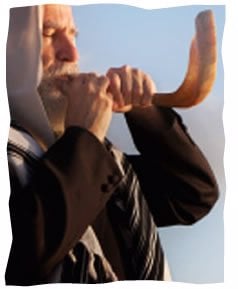
There are different customs as to how many times the shofar is blown on Rosh Hashanah. In most communities, the shofar is blown one hundred times. Here’s how we arrive at that number:
The Torah tells us to blow a teruah from a shofar on Rosh Hashanah. A teruah is a broken-sounding blast which resembles a cry. This commandment is repeated in three different places.1 The Talmud understands this repetition to imply that we must hear three teruahs. The Talmud also derives from other scriptural verses that each teruah must have a simple, unbroken blast (called a tekiah) before and after it.2 Thus the Torah requires us to blow nine blasts, as follows:
tekiah, teruah, tekiah
tekiah, teruah, tekiah
tekiah, teruah, tekiah.
The problem is that the word teruah can have multiple meanings. The Talmud tells us that there are three possibilities: It can mean several extremely short blasts, similar to how one would ululate in a tragic situation. Or it can mean three somewhat longer blasts, similar to how one would moan when he has great worries. A third possibility is that the teruah the Torah mentions is both of these cries together: a moan, followed by an ululation.3 Today the moan-like sound is known as shevarim, and the ululation as teruah. To make sure that we cover all bases, we blow all the different possible teruahs with a tekiah before and after each one, in the following order:
tekiah, moan-ululation, tekiah
tekiah, moan-ululation, tekiah
tekiah, moan-ululation, tekiah
tekiah, moan, tekiah
tekiah, moan, tekiah
tekiah, moan, tekiah
tekiah, ululation, tekiah
tekiah, ululation, tekiah
tekiah, ululation, tekiah
By blowing these thirty blasts, we fulfill our scriptural obligation. To understand the reason for the next sixty blasts, we need a little background information about the Musaf Amidah of Rosh Hashanah. The Talmud tells us that G‑d says to us on Rosh Hashanah, “Say before Me [verses whose themes are] sovereignty, remembrances and shofar. Sovereignty, so that you should crown Me king over you; remembrances, so that I should remember you for good; and with what? With a shofar.”4
Following this rubric, the Musaf Amidah includes one blessing about G‑d’s sovereignty, another about how He remembers His creation, and a third about the power of the call of the shofar. After each of these three blessings, we blow ten blasts on the shofar:
tekiah, moan-ululation, tekiah
tekiah, moan, tekiah
tekiah, ululation, tekiah
Thus the shofar is blown thirty times during the Musaf Amidah.
When the chazzan repeats the Amidah, he repeats these three blessings—about sovereignty, remembrance and shofar—and the shofar is blown after each one, in the same order.
By now we’ve accounted for ninety blasts: thirty before the Amidah, thirty during the silent Amidah, and thirty during the chazzan’s repetition of the Amidah. It is customary to blow yet another ten blasts after the repetition of the Amidah, for a total of one hundred blasts.5
To understand the mystical significance of the one hundred blasts, check out One Hundred Sounds.
With wishes for an uplifting Rosh Hashanah and a sweet new year,
Rabbi Eliezer Posner












How much time is invested typically in the entire 100 trumpet blasts? Is it like the military with about 5-6 seconds each in rapid succession, or is it like a Macy's day parade that takes all day but wouldn't have to if they didn't milk it out for the showy display?? Basically, is it 10, 20, 60 minutes. Or an all day event?
Great question! the length of a tekiah both before and after the shvarim or teruah must be at least as long as the shvarim or teruah which it accompanies , therefore it takes about 2 or 3 seconds to blow a shavrim or teruah , the tekiah before and after must be at least 2 or 3 seconds long . since it takes longer than that to blow a shavrim teruah the tekiah has to equal that amount of time . during shofar blowing by many congregations its usually 4 or 5 seconds .
Each shever according to the Mishnah Baruah should be about 3 beeps long .
Wishing a Shana Tova !